
Responsive Banner Design

What is DNS Protection?

Given that DNS is a critical component of internet functionality, it is a frequent target for cyberattacks. Attackers may exploit vulnerabilities in DNS to redirect traffic, steal data, or launch further attacks.
By implementing robust DNS protection, organizations can significantly reduce the risk of successful attacks, safeguard sensitive information, and maintain operational continuity.
DNS protection also ensures that unauthorized users cannot exploit the DNS infrastructure to carry out harmful actions such as data exfiltration or malware distribution.

The silent DNS challenge: Exposing invisible threat pathways

Adversaries use DNS protocol to keep their communications covert and evade detection. In particular, modern malwares use DNS to establish a command and control channel and facilitate exfiltration to take advantage of the fact that DNS traffic is not typically analyzed by firewalls and IDS/IPS devices.
Seceon OTM Platform

Stop attackers who hide in DNS

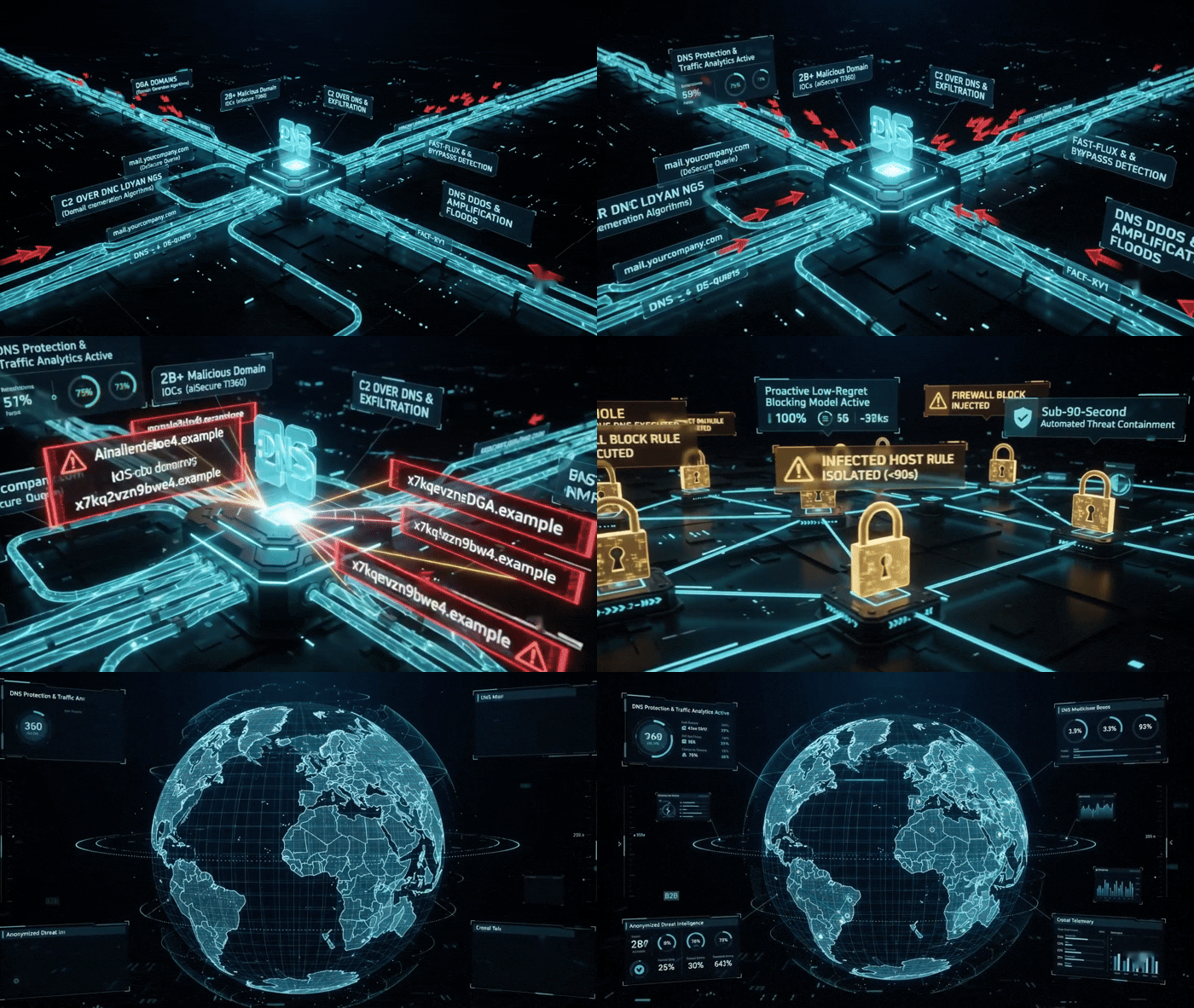
Detect DGA domains, DNS tunneling, fast-flux infrastructure and DDoS amplification, then block high-confidence threats automatically.

DGA Detection and Prediction Engine

Catch malware domains before they are listed

Identifies and predicts malware command-and-control hostnames generated by domain generation algorithms, before they are catalogued, using entropy and n-gram analysis.

Illustrative example.

WannaCryConfickerRamnitEmerging variants

DNS Tunneling alert

Data hidden in queries

Flags data encoded in DNS queries and responses using query length and entropy analysis.

C2 over DNSExfiltration over DNS

DNS anomaly detection

Suspicious domains

Watches for infrastructure attackers use to stay ahead of blocklists.

Fast-fluxNewly registered domainsDNS-over-HTTPS bypass

SNOED

Newly observed domains

Spots domains with unusual traffic spikes across customers, signaling campaign infrastructure before any external IOC is published.

DDoS alerts

Floods and amplification

Alerts on DDoS conditions, including amplification attacks that abuse third-party services to multiply traffic.

AmplificationTCP SYN floodICMP flood

Proactive Low-Regret Blocking Model

Block before confirmation

Uses probabilistic risk scoring to block high-confidence suspicious indicators before external validation is complete, reducing dwell time.

2B+

aiSecure TI360

Malicious domain intelligence

IOCs from 100+ sources across categories including C2 servers, DGA domains, phishing domains, botnet IPs and typosquatting domains.

Automated response

<90s

Containment through SOAR

Cross-Customer Global Correlation Engine

One detection protects everyone

When suspicious activity is detected at one site, correlated indicators propagate to protect all customers. New intelligence is also re-checked against historical telemetry.

Anonymized sharingRetrospective hunting

DNS Protection FAQs

Learn how DNS tunneling detection, DGA analysis, threat intelligence, and automated response help organizations defend against DNS-based attacks and protect critical infrastructure with Seceon.

How can I detect DNS tunneling and data exfiltration over DNS?

DNS tunneling hides data inside DNS queries and responses, which lets attackers move information out of a network or run command and control (C2) channels through traffic that firewalls and IDS/IPS devices do not usually analyze. Detection typically relies on examining query length, the entropy (randomness) of subdomain strings, query frequency to a single domain, and unusual patterns in responses, then correlating those signals with the host that generated them.

Seceon's OTM Platform flags data encoded in DNS queries and responses using query length and entropy analysis, and supports detection of C2 over DNS and exfiltration over DNS. Detection effectiveness depends on the DNS telemetry available, the configuration, and the technique used by the attacker.

What are the best DNS security and DNS threat detection solutions for enterprises in 2026?

The best DNS security solution depends on an organization's network architecture, threat profile, integration needs, and response requirements. Enterprises should evaluate solutions based on DGA and tunneling detection, visibility into newly registered and newly observed domains, threat intelligence coverage, automated blocking options, false-positive controls, and integration with SIEM, SOAR, and firewall tools.

Solutions that connect DNS analytics with broader security operations help teams act on DNS signals instead of reviewing them in isolation. Seceon's OTM Platform is an option for organizations that want DNS threat detection alongside AI/ML-driven analytics, threat intelligence, and automated response. Enterprises should validate supported integrations, deployment requirements, and response workflows against their own environment before selecting a platform.

How do organizations detect DGA domains and malware command-and-control traffic over DNS?

Many malware families use domain generation algorithms (DGAs) to create large numbers of pseudo-random domain names, so infected hosts can keep reaching their C2 servers even when individual domains are blocked. Because these domains change constantly, blocklists alone fall behind. Detection commonly combines lexical analysis such as entropy and n-gram scoring with threat intelligence and monitoring of which hosts are making repeated failed or unusual lookups.

Seceon's OTM Platform includes a DGA detection and prediction engine that uses entropy and n-gram analysis to identify and predict malware C2 hostnames before they are catalogued, including patterns associated with families such as WannaCry, Conficker, Ramnit, and emerging variants. Results depend on telemetry coverage and configuration, and no platform can guarantee detection of every DGA-based threat.

How can I detect fast-flux domains, newly registered domains, and DNS DDoS amplification attacks?

Attackers use fast-flux networks, freshly registered domains, and DNS-over-HTTPS (DoH) to stay ahead of blocklists and avoid inspection, while DNS-based DDoS attacks abuse third-party services to multiply traffic. Detection usually involves watching for rapidly changing resolution patterns, domains with little or no history, encrypted DNS used to bypass controls, and traffic volume that matches flood or amplification behavior.

Seceon's OTM Platform monitors for suspicious domain infrastructure such as fast-flux, newly registered domains, and DoH bypass, and spots newly observed domains with unusual traffic spikes across customers. It also raises alerts on DDoS conditions, including amplification, TCP SYN flood, and ICMP flood. Actual detection depends on the network data available and how the environment is configured.

Can DNS protection block malicious domains before they appear in threat intelligence feeds?

Yes, some approaches can act earlier than traditional feed-based blocking. Instead of waiting for a domain to be confirmed and published as an indicator of compromise (IOC), risk-based models score suspicious behavior and block high-confidence indicators first. This can reduce attacker dwell time, but it works best with sensible thresholds, review workflows, and allowlists to manage false positives.

Seceon's OTM Platform uses a proactive low-regret blocking model with probabilistic risk scoring to block high-confidence suspicious indicators before external validation is complete. Its cross-customer correlation engine can also propagate correlated indicators, using anonymized sharing, to protect other customers and re-check new intelligence against historical telemetry through retrospective hunting. Blocking behavior should be reviewed against each organization's own policies before enabling it.

How does DNS protection work with SIEM and SOAR to automate threat response?

DNS protection becomes more effective when DNS detections feed into a SIEM for correlation and a SOAR workflow for response. This lets teams enrich a suspicious lookup with threat intelligence, link it to the affected host, and trigger containment steps such as sinkholing a malicious domain, adding a firewall block rule, or isolating an infected endpoint, rather than handling each step manually.

Seceon's OTM Platform combines DNS threat detection with aiSecure TI360 threat intelligence, which draws IOCs from over 100 sources across categories such as C2 servers, DGA domains, phishing domains, botnet IPs, and typosquatting domains. Automated response through SOAR can sinkhole malicious DNS, inject a firewall block rule, or isolate the infected host. Available actions and response times depend on the integrations and automation settings in each deployment.

Summary Section

Summary

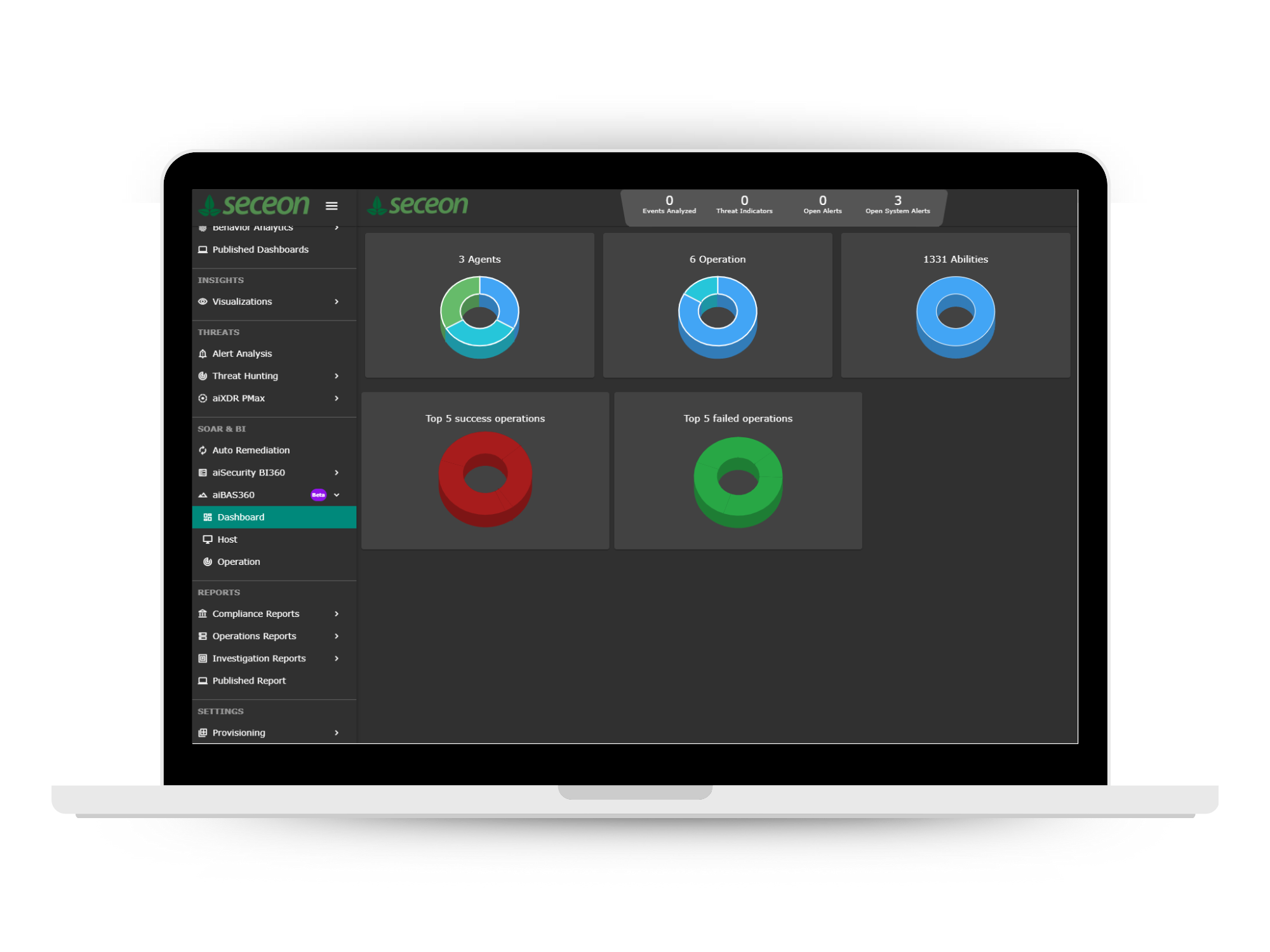
Seceon’s AI-driven DNS protection solution monitors and analyzes DNS traffic, detecting malicious domains and blocking threats in real-time to prevent unauthorized access, ensuring secure and resilient DNS operations.

Seceon aiSIEM-CGuard

24/7 Access to Seceon’s Cybersecurity Experts - Because Threats Don’t Wait

Do These Persistent Issues Impact Your Day-to-Day Operations?
  • Large number of failed logins from single/multiple IPs, internal or external, against a single/multiple usernames.
  • Failed logins from new geo locations or a new user device.
  • Large number of account lockouts.
  • High cost of integration, support and maintenance.

    wpChatIcon
    wpChatIcon