Multi-cloud coverage
AWS, Azure and GCP in one view
Cloud findings use the same event format as on-premises data, so cloud and IT threats are correlated together.
Posture findings reach the correlation engine within 5 minutes of scan completion.
Seceon’s Cloud Security offers advanced threat detection and defense, securing cloud environments from vulnerabilities, data breaches, and evolving cyber threats.
Book a demo
Managing the intricate layers of cloud-based infrastructure can increase operational complexity.
Ensuring the cloud environment is compliant with regulatory standards while maintaining security.
Seamlessly integrating cloud security with existing on-premises systems can be difficult.
Maintaining cloud security often involves significant costs and resource allocation.
Security teams may experience alert fatigue due to the high volume of security alerts in cloud environments.
Cyber threats are continuously evolving, making it difficult to stay ahead in cloud security.
Posture management and cloud threat detection for AWS, Azure and GCP, correlated with on-premises activity in one engine.
Multi-cloud coverage
Cloud findings use the same event format as on-premises data, so cloud and IT threats are correlated together.
Posture findings reach the correlation engine within 5 minutes of scan completion.
CSPM
Finds misconfigurations across compute, storage, networking, identity and data services.
CDR
Real-time detection of attacks inside cloud environments.
Behavioral analytics
Learns normal CloudTrail API call patterns and flags anomalies.
Cloud identity
Detects IAM policy anomalies and identity abuse in the cloud.
Automated response
Cloud response actions run through aiSOAR.
Built into aiSIEM
Connects to AWS, Azure and GCP through native APIs, read-only unless you authorize response actions.
Also connects to SaaS and identity sources such as:
Compliance mapping
Cloud posture findings are mapped to CIS Benchmarks and these frameworks.
Forensic retention
WORM-compliant storage with chain of custody, searchable across the full retention window.
Detection of compromised credentials, reducing unauthorized access risks.
Prevention of brute-force attacks through real-time monitoring.
Blocking of unauthorized access to blacklisted or harmful sites.
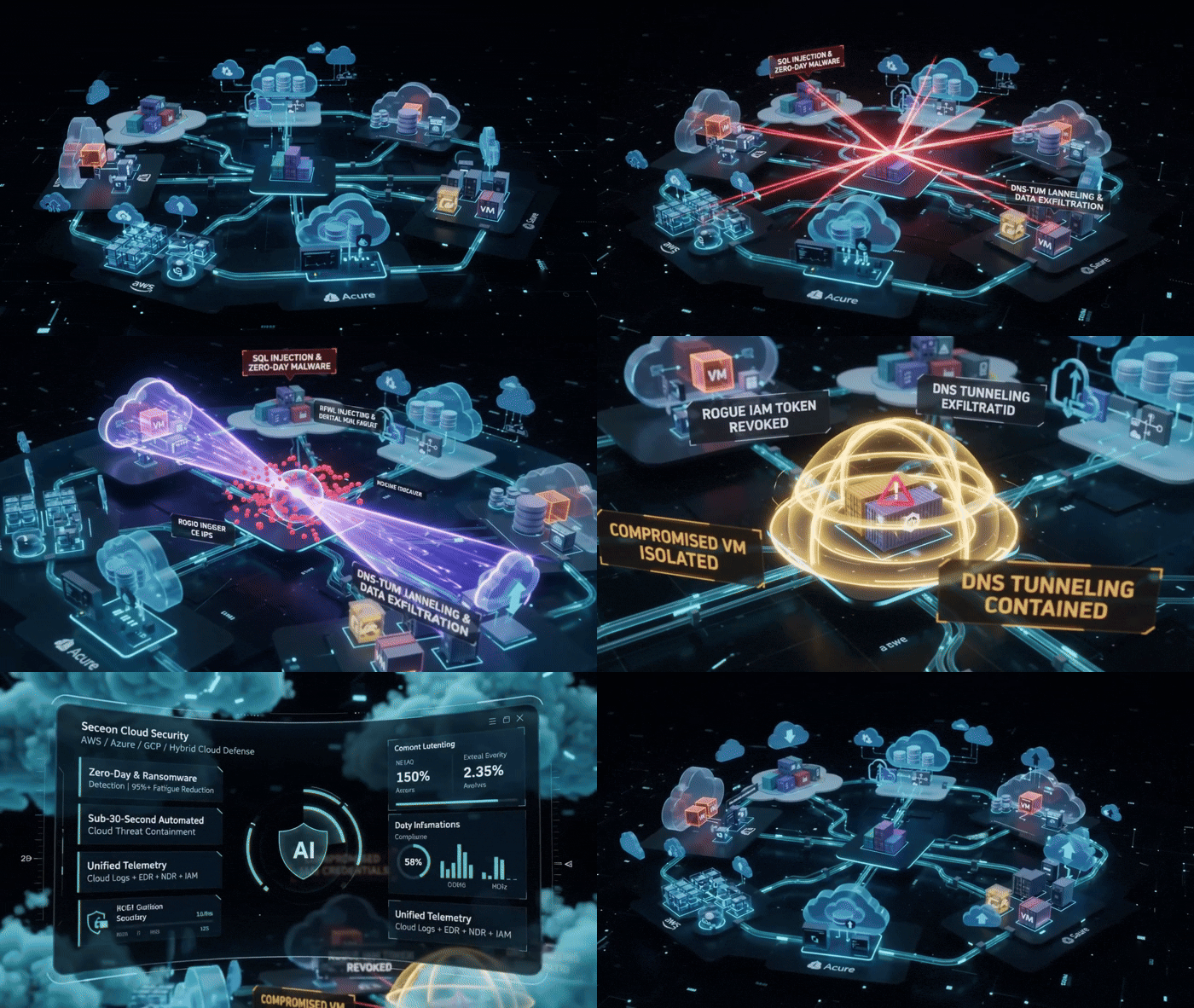
Prevents SQL injection attacks, protecting databases and applications.
Detecting and blocking potential ransomware threats.
Protection against unknown or zero-day malware.
Mitigating distributed denial-of-service attacks.
Monitoring and preventing trojan activity in cloud environments.
Prevention of DNS tunneling attacks that misuse the DNS protocol.
Learn how cloud posture management, cloud threat detection, identity risk monitoring, and automated response help organizations secure AWS, Azure, and GCP environments with Seceon.
Organizations can secure multi-cloud environments from one place by using a platform that collects security telemetry from AWS, Azure, and GCP, normalizes it into a common format, and correlates it with on-premises activity. Managing a separate console for each cloud often leads to blind spots, duplicated effort, and delayed investigations.
Seceon's aiSIEM-CGuard connects to AWS, Azure, and GCP through native APIs and uses the same event format as on-premises data, so cloud and IT threats can be correlated together in one engine. It does not require a separate console, API, or agent, and connections are read-only unless response actions are explicitly authorized. Supported data sources depend on your cloud services and configuration.
The best cloud security platform depends on an organization's cloud providers, compliance requirements, team size, integration needs, and response capabilities. Enterprises should evaluate solutions based on multi-cloud coverage, posture management, real-time threat detection, identity risk visibility, response automation, and how well cloud data is correlated with on-premises security events.
Platforms that unify cloud security with SIEM can help teams investigate cloud and on-premises activity together instead of switching between separate tools. Seceon's aiSIEM-CGuard is an option for organizations seeking cloud posture management and cloud threat detection for AWS, Azure, and GCP built into a SIEM. Enterprises should validate supported integrations, deployment requirements, and response workflows against their own environment before selecting a platform.
Cloud Security Posture Management (CSPM) identifies misconfigurations across compute, storage, networking, identity, and data services, while Cloud Detection and Response (CDR) detects active attacks inside cloud environments, such as bucket exfiltration attempts or cross-account role anomalies. Most organizations benefit from both, because a misconfiguration combined with an active threat creates the highest risk.
Seceon's aiSIEM-CGuard includes posture management with automated CIS Benchmark assessment and real-time cloud threat detection in the same platform, and correlates misconfigurations with active threats to provide context. Posture findings reach the correlation engine within 5 minutes of scan completion. Actual detection coverage depends on connected cloud services and configuration.
Organizations can detect compromised credentials and risky IAM permissions by baselining normal API activity, monitoring identity behavior, and flagging anomalies such as role chaining, federated abuse, unusual cross-account access, and over-permissioned service accounts. Monitoring failed logins, brute-force attempts, and new-location access also helps reveal credential-based attacks early.
Seceon's aiSIEM-CGuard learns normal CloudTrail API call patterns and flags anomalies, and it detects IAM policy anomalies and identity abuse in the cloud, along with compromised credentials and brute-force attacks. Detection effectiveness depends on the quality of available telemetry and how the cloud environment is configured.
Organizations looking for automated cloud response should evaluate platforms that combine cloud threat detection with orchestrated response actions, such as fixing risky configurations, rolling back network rules, rotating credentials, and isolating affected workloads. Automation helps reduce response time and alert fatigue, but it should include approval controls and auditability.
Seceon's aiSIEM-CGuard runs cloud response actions through aiSOAR, including auto-remediating S3 bucket ACLs, rolling back security group rules, rotating IAM keys, and isolating a cloud instance. Cloud connections remain read-only unless you authorize response actions. Organizations should confirm which automation actions are available for their specific deployment before implementation.
Organizations should look for cloud security platforms that map posture findings to recognized benchmarks and regulatory frameworks, and that retain tamper-proof logs for audits and forensic investigations. Key evaluation criteria include framework coverage, log integrity, chain of custody, retention period, and search performance across historical data.
Seceon's aiSIEM-CGuard maps cloud posture findings to CIS Benchmarks and to frameworks including SOC 2, PCI-DSS, HIPAA, GDPR, DPDPA, FedRAMP, and CMMC. It also provides WORM-compliant, tamper-proof log storage with chain of custody for up to 7 years of forensic retention, searchable across the full retention window. Achieving compliance still depends on an organization's own controls, policies, and configuration.
Seceon’s AI-powered Cloud Security solution continuously monitors cloud environments, identifies potential threats and vulnerabilities in real-time, and automatically responds to incidents, ensuring comprehensive protection and resilience against cloud-based attacks.
Copyright @Seceon Inc 2026. All Rights Reserved.